
Brawl Stars Championship 2026: How to Qualify and Compete
The 2026 Brawl Stars Championship comes down to one number: 15. Win 15 matches before racking up 4 losses in the in-game Championship Challenge, and you’re through to the Monthly Qualifier. From there, a top-8 finish sends you to Monthly Finals, where points accumulate toward the Brawl Cup, the Last Chance Qualifier, and ultimately a shot at the $1,000,000 World Finals.
Part of what’s kept the circuit growing season over season is the game’s staying power years after launch, which keeps regional qualifier fields deep. Here’s exactly how each stage works, sourced against Supercell and BLAST’s official 2026 rulebook.
Key Takeaways
Before the walkthrough, here’s the shape of the season: BSC 2026 runs as two splits, Spring (February through April) and Summer (June through August), each made up of three online seasons that feed a Championship Challenge into a Monthly Qualifier and then a Monthly Final. Summer Split points are worth 1.5x their Spring value, so the back half of the year carries more weight on the regional leaderboard.
Entry never changes: 15 wins before 4 losses in the Championship Challenge, playing solo or with a premade group, gets you into the Monthly Qualifier pipeline. Rosters for the Monthly Qualifier itself are capped at three active players. This isn’t a 2–4 player format, despite what a lot of guides (including earlier versions of this one) have claimed. Two offline events sit between the regional grind and the finish line: the Brawl Cup in May and the Last Chance Qualifier in October, both feeding the 12-team, $1,000,000 World Finals in Tokyo this November.
The 2026 Brawl Stars Championship Season Structure, Explained
BSC 2026 runs across two splits: Spring (February through April) and Summer (June through August), each containing three monthly online seasons, with every season working through a Championship Challenge, a Monthly Qualifier, and a Monthly Final. Per the official BSC 2026 rulebook, Summer Split match wins and Monthly Finals placements are worth 1.5x their Spring Split value. Spring’s first-place Monthly Finals prize is 60 leaderboard points, while a Summer first-place finish is worth 90.
Between the two splits, the Brawl Cup brought 12 teams to Berlin, Germany for a $100,000 offline event, with the winning region earning a direct World Finals slot and the runner-up region earning a Last Chance Qualifier slot. If a team doesn’t lock in a spot through the regional leaderboard or the Brawl Cup, the Last Chance Qualifier in October gives eight teams one more shot, with the top two advancing to World Finals. Rosters do shift throughout the year within the rulebook’s limits, as seen when Secondbest replaced Steel on the Enosis eSports roster in March.
How the Championship Challenge Works
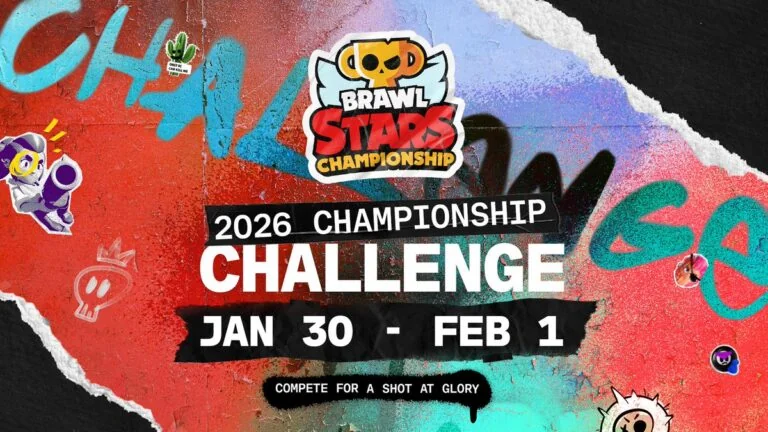
Every Championship Challenge is a three-day window where the target is fixed: 15 wins before 4 losses. That’s it. There’s no 3-loss variant, despite some regional guides implying otherwise; the official rulebook sets the loss limit at four across every region and every season. Hit that fourth loss and you’re done until the next monthly window.
Matches are Best-of-1 sets, and you can enter solo or with a premade group; Supercell’s own guidance notes that playing with friends improves your odds of clearing the gate cleanly. The Spring Split’s first Championship Challenge opened January 30, kicking off the season.
Win Requirements Explained
Six Championship Challenges run across the year (three per split), each lasting 72 hours. During Season 3 (March 27–29), Supercell layered in an added incentive: a Chaos Drop for every third win, a randomized reward that can include currency or skins. That reward structure has since extended further into the season: Monthly Qualifier competitors earn a Chaos Drop for every round completed on Day 1, and Monthly Finals players earn one per round as well.
Community coverage of past seasons puts the practical entry bar at roughly 800 Trophies before a Championship Challenge attempt is worth making, though that specific threshold isn’t spelled out in the BLAST rulebook itself, so treat it as a rule of thumb rather than an official cutoff.
What is confirmed: matches run Best-of-3 across rotating modes, including Bounty, the Gem Grab mode, and Knockout. Brawler stats also get boosted for the event, letting you run a Star Power, a Gadget, two Gears, and a Hypercharge upgrade once you hit the boosted power level.
Qualifying Through Losses
The 15-win target gets the attention, but the 4-loss ceiling is what actually ends most runs. Once a fourth loss lands, that Championship Challenge is over for the season. There’s no partial credit and no continuing into the next round. What softens the blow: elimination is never permanent.
A new Championship Challenge opens the following month, your loss count resets, and nothing from a prior attempt carries a penalty into the next one. Reforming a roster between attempts is common, and tighter team coordination is one of the more reliable ways to keep losses down: you’re managing four lives across the whole team, not four lives each.
How to Form or Join a Team for the Monthly Qualifier
Once you’ve cleared the Championship Challenge, forming a Monthly Qualifier roster starts with registering on the official Esports Hub and linking a Brawl Stars Player Tag. This is the point where a lot of write-ups (including older versions of this page) get the roster size wrong: per the rulebook, a Monthly Qualifier roster is capped at three active players, not a 2–4 player range.
That three-player cap is what shows up on stream, in the bracket, and in the match lobby. A fuller five-person roster (three active players plus a coach and a substitute) only comes into play once a team reaches Monthly Finals or an offline event.
Looking to join an existing team rather than build one from scratch? The BSC Discord server is where most of that recruiting actually happens, and teams there are typically looking for players who’ve already cleared the 15-win Championship Challenge on their own, since that’s a Monthly Qualifier eligibility requirement, not something a team can vouch for on your behalf.
Every player needs a Brawl Stars account linked to a Supercell ID, and the rulebook’s residency requirements (not citizenship, despite how some guides phrase it) determine which region you’re eligible to compete in. Registration itself is free, with no entry fee at any stage of BSC 2026.
How to Qualify Through the Monthly Qualifiers
The Monthly Qualifier itself runs in two parts. Day 1 is a single-elimination bracket where match wins bank leaderboard points and the top 16 advance. Day 2 flips to double elimination: the Day 1 survivors join the region’s top-seeded teams from the regional leaderboard, and the bracket runs Best-of-5 sets rather than Day 1’s Best-of-3. Finish in the top 8 on Day 2, and the team moves directly into Monthly Finals, still carrying forward every point earned across both days.
How Monthly Finals Points and Prizes Work in BSC 2026
Monthly Finals is where regional leaderboard points really start to separate teams, and it’s also where the split multiplier matters most, since Summer Split placements are worth 1.5x their Spring value.
| Placement | Spring Split Points | Summer Split Points |
|---|---|---|
| 1st | 60 | 90 |
| 2nd | 40 | 60 |
| 3rd-4th | 20 each | 30 each |
| 5th-8th | 10 each | 15 each |
Points are the same across every region: East Asia, EMEA, South America, and North America all use this table. Prize money is where regions diverge: North America’s per-region Monthly Finals pool runs $12,000 for first, $7,000 for second, $3,500 for 3rd-4th, and $2,000 for 5th-8th, for a $34,000 regional total. EMEA and East Asia’s pools run slightly higher at $42,000 and $40,000 respectively, while South America’s sits at $31,000. North America’s March Finals played out exactly to that table: first place walked away with $12,000 and 60 Spring Split points, second with $7,000 and 40 points.
How the Brawl Stars Brawl Cup Works
Monthly Finals points determine who gets invited to the Brawl Cup, the season’s midpoint LAN event. It ran May 15-17, 2026 at Berlin’s Uber Eats Music Hall, with 12 teams competing for a $100,000 prize pool, not the $50,000 figure that’s circulated in some earlier coverage of this event. Here’s how the bracket actually played out:
The group stage split the 12 teams into four groups of three, played as a single round-robin, and the top two from each group (eight teams total) advanced to playoffs. From there, playoffs ran GSL-style: two pools of four, needing two match wins to advance and two losses to be out. In the semifinals, HMBLE handed Over Realm a lopsided defeat, while ZETA DIVISION took a similarly dominant victory over Bounty Hunters, a result worth noting given ZETA DIVISION had also taken the East Asia February Finals, suggesting their early-season form wasn’t a fluke.
Roster-building skill showed up in the picks, too: several playoff teams leaned on off-meta choices like Tick rather than the safest, most obvious comp. First place in Berlin earned the winning team’s home region a direct World Finals slot; second place earned its region a Last Chance Qualifier slot instead.
How to Earn Free Viewership Rewards During BSC 2026
Competing isn’t the only way to get something out of BSC 2026. Supercell runs a parallel viewership rewards track for fans watching from home, and it’s separate from the in-game Chaos Drops competing players earn. For events like the Brawl Cup, you log into the official broadcast hub at event.brawlstars.com with your Supercell ID, then bank points by predicting match winners before each day starts, cheering during the stream, and answering trivia questions that pop up between games.
Those points unlock a reward track in your in-game inbox, with a free Hypercharge typically unlocking around the 1,400-point mark, one of the better pulls in the whole track. Monthly Finals broadcasts and the World Finals run similar prediction-and-cheer reward tracks of their own, and some of what you’ll pull is cosmetic. If a Chaos Drop lands you a skin you don’t already have queued up, it’s worth checking whether it’s also available through a currently active free skins code before spending on it separately.
How the Last Chance Qualifier Works
Teams that fall short of a direct World Finals slot get one more chance at the Last Chance Qualifier (LCQ), an eight-team, offline S-Tier event organized by Supercell and BLAST, scheduled for October 2026 (some regional outlets have reported specific dates of October 17-18, though the official rulebook lists the month without a confirmed day as of its latest published revision). Only the top two teams leave with World Finals spots.
Teams and Qualification
The eight LCQ spots aren’t awarded evenly: they follow the same regional leaderboard structure that seeds the rest of the season. Per the official slot allocation table, East Asia, EMEA, South America, and North America each get one leaderboard-based LCQ slot; Chinese Mainland gets two; the Brawl Stars Challengers circuit contributes one; and the Brawl Cup runner-up’s home region gets the eighth. That’s a narrower, more structured path than “global invitations” might suggest. Every LCQ seed traces back to a result earned somewhere else in the season.
Advancing to World Finals
The LCQ plays out across two days in a straight win-or-go-home format, with an $18,000 prize pool split among all eight teams. Third place alone takes $6,000, with smaller shares down through eighth. Every match is played face-to-face with live broadcast, and Global and Visible Match Bans add a layer of pre-match strategy that the online qualifiers don’t have. Win your way through, and the reward is a seat at the World Finals, where the season’s $1,000,000 prize pool is on the line, not the $2 million figure that’s been misreported elsewhere.
Brawl Stars World Finals 2026: Format, Location, and Prize Pool
The 12 teams that survive the regional leaderboards, Brawl Cup, and Last Chance Qualifier all end up in the same place: Tokyo. Supercell and BLAST confirmed the 2026 World Finals will run November 20-22 at the Tokyo Metropolitan Gymnasium, the first time the event has been hosted in Asia since 2019 and, by Supercell’s own framing, the biggest in-person Brawl Stars event to date. General ticket sales opened August 1, with doors at the venue opening at 10:00 JST each day.
The bracket splits across all three days. Friday’s Group Stage puts eight teams into two GSL-style groups playing Best-of-5 sets, while the four regional #1 seeds skip the group stage entirely and drop straight into Saturday and Sunday’s double-elimination Playoffs alongside the group stage’s four survivors. Sunday’s Grand Final is a Best-of-7, with the team that came through the Upper Bracket starting the match with a one-set lead already banked, a real edge given how tight BSC brackets have run all year.
All 12 teams are battling for a share of the $1,000,000 prize pool, with slot totals mirroring the regional split used all season: EMEA sends four teams (including any bonus slot won at the Brawl Cup), North America, South America, and East Asia send two each, and the Last Chance Qualifier supplies the final two.
New Map Bans, Unified Entry Path, and Other 2026 Format Changes
2026 brought a genuine structural shift to BSC, not just a numbers refresh. The old Pro Rank shortcut into Monthly Qualifiers is gone. Every team now clears the same Championship Challenge, at the same 15-wins-before-4-losses bar, regardless of in-game rank. Map selection changed too: teams now pick maps directly during a Pre-Match Draft rather than having them assigned, and Global Match Bans let each team ban brawlers for the entire match rather than just a single set.
The path to competition is now singular: no rank shortcuts, just Championship Challenge and Monthly Qualifiers for everyone.
In practice, that draft-first structure has already shaped how teams build rosters. The Brawl Cup semifinals showed comp diversity mattering more than in past years, with teams like HMBLE and ZETA DIVISION winning convincingly by adapting picks match to match rather than leaning on one fixed comp. That’s less a coincidence than a direct consequence of giving both teams map and ban control up front.
Conclusion
Every path through BSC 2026 starts the same way: 15 wins, 4 losses, no shortcuts. From there it’s Monthly Qualifiers, Monthly Finals, and, for the teams that keep clearing each bar, the Brawl Cup or Last Chance Qualifier as a bridge to Tokyo and the $1,000,000 World Finals. The format changed more than the numbers this year: everyone enters through the same gate, map and ban control now sits with the teams instead of being handed to them, and there’s a whole separate rewards track for anyone watching rather than competing. Get the roster size and the loss limit right, and the rest of the season structure is straightforward from here.
Frequently Asked Questions
What Supercell ID Requirements Must Players Meet Before Registering?
A valid Brawl Stars account linked to a Supercell ID is required before you can register for any BSC event. Without that link, you can’t enter Monthly Qualifiers or any later stage.
Is There an Entry Fee to Compete in BSC 2026?
No. Registration is free at every stage, from the in-game Championship Challenge through the Monthly Qualifiers.
Can Players Compete in Multiple Regions During the Same Season?
No. Once a team starts competing in a region, it’s locked there for the season. Switching regions means disbanding the current team, forfeiting all points earned, and starting over under a new team in the new region.
Are There Age Restrictions for Participating in BSC 2026 Events?
Yes. Participants must be 16 or older by the time registration closes for that season’s Monthly Qualifiers and Monthly Finals. The official rulebook doesn’t specify a separate consent process for players under 18.
How Are Tiebreakers Handled When Teams Share Identical BSC Points?
The rulebook runs through tiebreakers in order: head-to-head record first (skipped if three or more teams are tied), then total first-place Monthly Finals finishes, then average Monthly Finals placement, then total match win percentage, then set win percentage, then game win percentage, with each one only coming into play if the previous criterion is also tied.
What Happens if a Team Disbands After Qualifying for Monthly Finals?
The rulebook’s disqualification rules give the clearest signal here: a vacated spot typically passes to the next team in line, and any points or slots tied to the disbanded roster are forfeited rather than transferred.
